
CTV (connected TV) advertising is video advertising delivered over the internet to TV screens: smart TVs, streaming sticks, consoles and set-top boxes. In the UK it combines TV’s big screen with digital buying and targeting, and it’s growing fast: IAB UK’s Compass report says around three quarters of UK households own CTV devices, and CTV accounts for about 28% of viewing on a TV set among adults, rising to 55% among 16 to 34s.
This guide explains how CTV works in the UK, where the inventory actually is, how it’s bought and what that means for your creative. For files, lengths and loudness, see our CTV ad specs guide. We make CTV spots alongside display and social through our CTV production service.
Key Takeaways
- CTV is any ad shown on a TV screen through an internet connection; OTT describes the streaming service, on any device.
- In the UK, the biggest ad-funded CTV inventory is broadcaster video on demand (BVOD): ITVX, Channel 4’s streaming service and others, plus ad tiers from streamers.
- CTV can be bought direct from broadcasters and platforms or programmatically through DSPs and exchanges.
- Ads are usually 15 or 30 seconds and non-skippable, delivered as high-quality video files or VAST tags.
- Creative is TV creative: sound on, viewed from the sofa, with targeting more like digital.
| Term | What it means | Example |
|---|---|---|
| CTV | The TV screen connected to the internet | Smart TV, Fire TV Stick, games console |
| OTT | Streaming content delivered over the internet, on any device | A streaming app on a phone or TV |
| BVOD | Broadcasters' on-demand services | ITVX, Channel 4 streaming, STV Player |
| AVOD / FAST | Free ad-supported streaming services and channels | Free streaming channels on smart TVs |
| Linear TV | Scheduled broadcast TV | Live ITV or Channel 4 schedule |
What Is CTV Advertising?
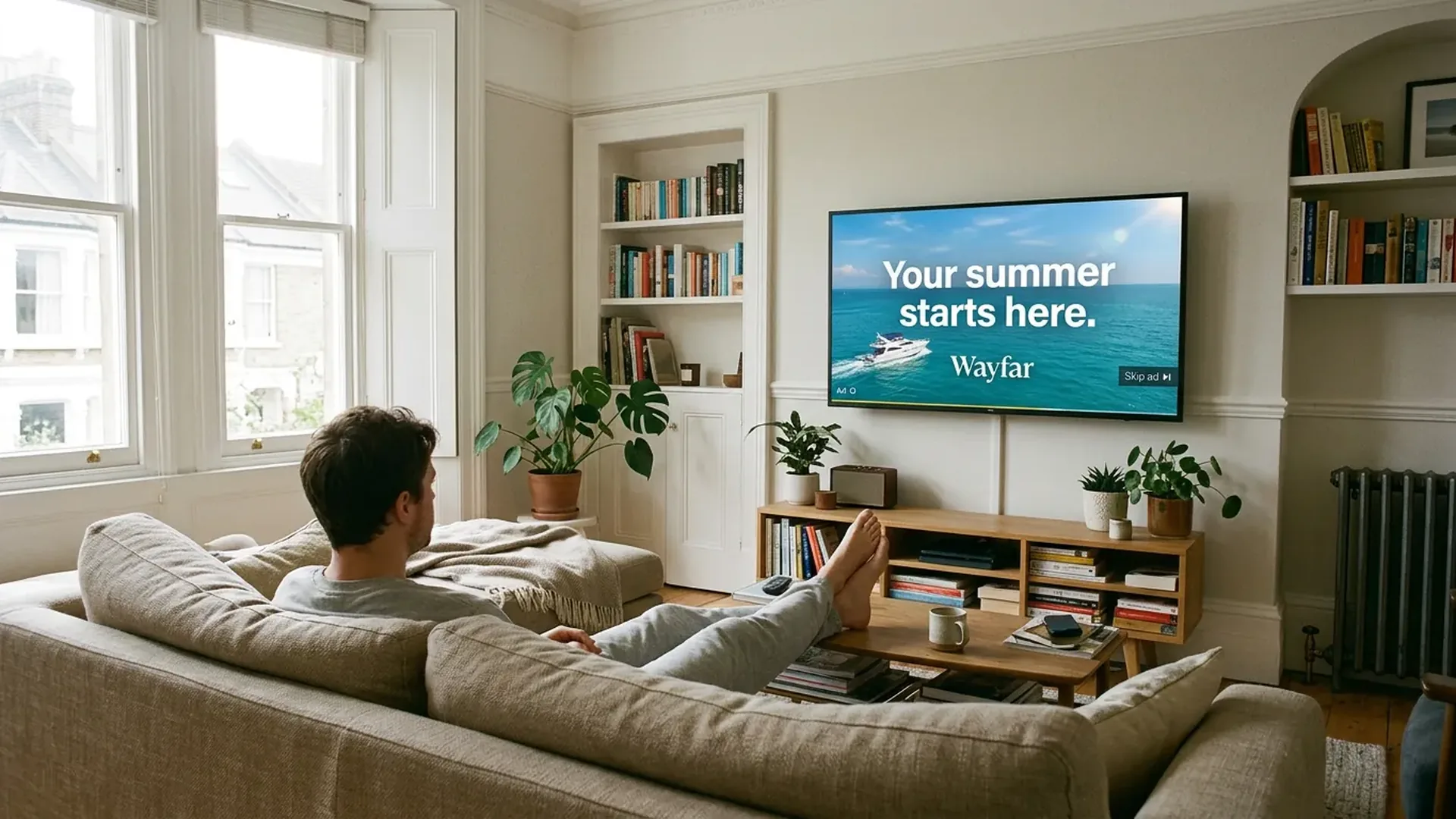
CTV advertising is video ads shown on a TV screen through an internet connection, inside streaming services and apps. Unlike linear TV, where everyone watching a programme sees the same break, CTV ads are served per household, so they can be targeted by audience, location or interest, and measured more like digital.
Where Is the CTV Inventory in the UK?
The UK is different from the US. Thinkbox, the UK TV marketing body, points out that broadcaster VOD is the prime CTV advertising opportunity here, and that BARB data shows little measurable viewing of non-broadcaster ad-funded services. In practice, most UK CTV budgets go to:
- Broadcaster VOD (BVOD): the streaming services of ITV, Channel 4, Sky and others.
- Streamer ad tiers: ad-supported plans from major subscription streaming services.
- Platform and device inventory: home screens and channels on smart TV and streaming platforms.
- FAST channels: free ad-supported streaming channels, a smaller but growing slice.
How Is CTV Bought?
There are two main routes. Direct, booking with a broadcaster or platform’s sales team, often with guaranteed delivery. Or programmatic, through a DSP such as The Trade Desk or DV360 and exchanges including ITV’s Planet V, FreeWheel and Magnite. Programmatic makes it easier to use audience data and manage frequency across services; direct deals often give access to premium programming and formats.
Pricing is usually on a cost per thousand impressions (CPM), and higher than online video because the ads are full-screen, non-skippable and watched on the biggest screen in the house.

What Does CTV Mean for Your Creative?
- It’s still TV. Sound on, full screen, often watched with others. Make it work as a TV ad, not a social cut.
- 15 and 30 seconds are the standard lengths; supply both for the widest reach.
- Broadcast-quality files: high-bitrate masters, 16:9, correct loudness. Our CTV ad specs guide covers the detail.
- Approvals: UK broadcast-style CTV inventory may need copy clearance before ads run, so allow time in the schedule.
- Versioning is possible: because CTV is served per household, you can rotate versions by region, audience or time, which linear TV can’t do.
- Add a next step: a short URL or QR code held on screen long enough to scan from the sofa.
For video on other screens, see YouTube bumper ads and video banner ads, and for the vendors behind many CTV campaigns, Flashtalking and Innovid.
Get Your CTV Ads Made
We edit and master CTV spots from your footage, in 15 and 30-second versions, to each platform’s spec. See our CTV production service or send us your footage.
From Our Studio
Real campaigns we’ve built, with the full story in each case study.

ElevenLabs
HTML5 display and rich media page takeovers on premium news sites, introducing the platform at scale.
Read the case study
Eternit
HTML5 display ads for fibre cement roofing, built to platform spec and designed to drive free sample requests.
Read the case study
Cedral
A multilingual HTML5 campaign across 7 countries, built as one flexible system for different personas and markets.
Read the case studyFAQ
What is CTV advertising?
CTV advertising is video advertising shown on TV screens through an internet connection, inside streaming services and apps on smart TVs, streaming sticks, consoles and set-top boxes.
What is the difference between CTV and OTT?
CTV refers to the device: a TV connected to the internet. OTT refers to the streaming content, which can be watched on any device, including phones and laptops.
Where can you buy CTV ads in the UK?
Mostly on broadcaster video on demand such as ITVX and Channel 4’s streaming service, on ad-supported tiers of streaming services and on smart TV and streaming platforms, either direct or programmatically.
How much does CTV advertising cost?
CTV is usually priced per thousand impressions (CPM) and costs more than online video because ads are full-screen, non-skippable and watched on the main TV.
What creative do CTV ads need?
Usually 15 and 30-second, non-skippable, 16:9 TV-quality video with correct loudness, delivered as a high-quality file or VAST tag.
Need help with
creative production?
If you’re planning a campaign or need reliable digital creative production at scale, we can help. Send us your requirements and we’ll advise on formats, builds and delivery.
Planning a CTV campaign? We build interactive video and the matching display set, scoped and priced upfront.